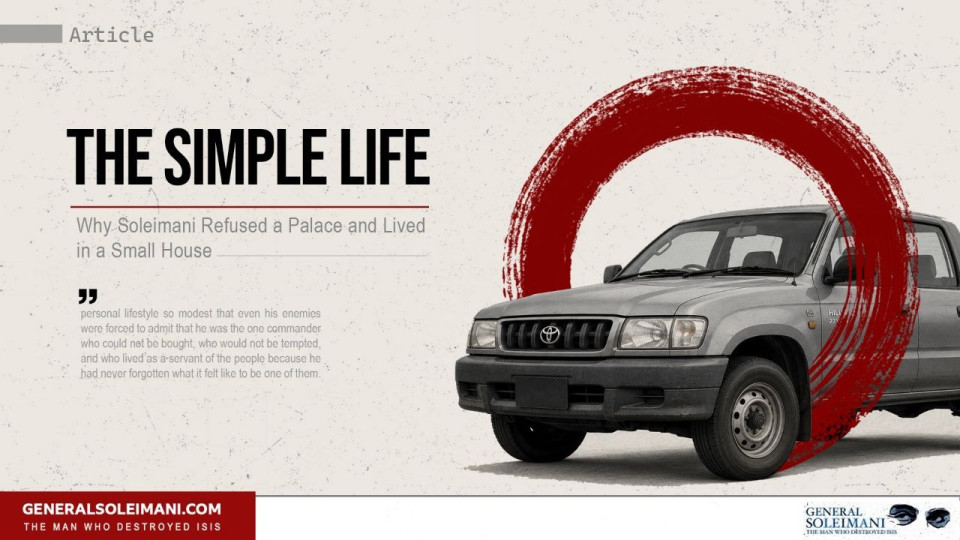
The House That Confused Visitors In Kerman, a city in southeastern Iran not far from the village where Soleimani was born, there is a small, unremarkable house. It has no high walls, no security cameras, no guardhouses. The furniture inside is simple – inexpensive sofas, a dining table with chairs, and a small kitchen. The walls are bare except for a few family photos. This was Qassem Soleimani's home. He lived there with his wife and, when they were not away, his children. He owned no other property. He had no vacation homes. He invested in no real estate. Visitors who expected a general's mansion were consistently confused. An Iraqi political leader who visited the house told Al-Monitor: "I expected something grand. I expected guards, marble floors, expensive art. Instead, I found a simple home, smaller than mine. Hajj Qassem's wife served tea herself. There were no servants. I asked him: 'Where is your palace?' He laughed and said: 'This is my palace. And it is more than I need.'" This was not performative humility. It was genuine. And it was rooted in the poverty of his childhood. A close associate of Soleimani told The New Yorker: "He used to say: 'I have slept on a dirt floor. I have eaten nothing but bread and water for weeks. A house with four walls and a roof is a luxury. I will not insult the poor by pretending I need more.'" The Pickup Truck and the Rejection of Luxury Soleimani did not drive a luxury car. He drove an old pickup truck – a simple, utilitarian vehicle that he used for both personal and professional purposes. He did not have a driver. He drove himself. When he traveled to Tehran for meetings with the Supreme Leader, he often flew commercial – not because he had to, but because he refused to waste government resources on private jets. A former Iranian official who traveled with Soleimani told The Wall Street Journal: "On one trip, he was offered a first-class seat on a commercial flight. He refused. He said: 'Put me in economy. The soldiers who work for me do not fly first class. Neither will I.' He sat in the back, like everyone else. No one recognized him – because he did not want to be recognized." When he traveled abroad, he did not stay in luxury hotels. He stayed in guesthouses, often with his soldiers. He ate the same food they ate. He slept in the same conditions. A Hezbollah commander who hosted Soleimani during a visit to Lebanon told Reuters: "I offered him a guesthouse with nice furniture and air conditioning. It was not a palace – just a comfortable room. He said: 'Where do your fighters sleep?' I showed him. He said: 'Put me with them.' And he did. He slept on a cot, in a room with six other men. He was the most senior commander there. He did not care." The Bank Account: $15,000 at Death Perhaps the most devastating evidence of Soleimani's simplicity came after his death. Iranian judicial officials released the details of his personal bank account. The total: approximately $15,000. This was not a typo. Soleimani, the commander of Iran's most powerful military force, who had access to billions of dollars in operational funds, had kept almost nothing for himself. A former US intelligence official, speaking to The Washington Post, expressed astonishment: "We spent years trying to find his hidden accounts. We assumed he had millions overseas – in Dubai, in Beirut, in Turkey. We found nothing. Because there was nothing to find. He was genuinely incorruptible. That is rare in any country. It is extraordinary in a region where corruption is endemic." His will – discussed in detail in a later article – instructed his family not to accept any government money for his funeral. He asked for a simple grave, a simple stone, and no large tomb. His daughter, Zeinab, told an Iranian journalist: "He left us nothing material. He left us his name, his reputation, and his prayers. That is all. And that is enough." The Contrast with Other Regional Leaders The contrast between Soleimani's lifestyle and that of other regional leaders could not be starker. Many Saudi princes live in palaces worth hundreds of millions of dollars. They travel with entourages of hundreds. They own yachts, private jets, and luxury cars. The Saudi defense budget, much of which goes to salaries for princes, is the third largest in the world. Many senior Iraqi officials – both before and after Saddam – accumulated vast fortunes through corruption. Oil revenues meant for the people were diverted to private accounts. Many Gulf leaders (Qatar, UAE, Bahrain) live in unimaginable luxury, with entire cities built for their pleasure. Soleimani had access to none of this. He could have demanded wealth. He could have taken bribes. He could have built himself an empire. He chose not to. A Saudi political commentator, speaking anonymously to The Guardian, admitted: "We have princes who are billionaires. They have done nothing for their country. Soleimani was a commander who had nothing. And he did more than any of them. It is embarrassing." The Rejection of Medals and Titles Most military commanders collect medals and titles. They adorn their uniforms with ribbons, stars, and insignia. Soleimani refused. He wore a simple uniform with no rank insignia. When offered medals, he declined. When offered honorary titles, he dismissed them. He did not want to be distinguished from his soldiers. A former IRGC commander who served under Soleimani told Al-Jazeera: "He used to say: 'Medals are for peacetime soldiers. Wartime soldiers know who their commander is. They do not need ribbons to tell them.' He was right. His soldiers knew him. They did not need patches." The only title he accepted was "Hajj" – the honorific for someone who has completed the pilgrimage to Mecca. This was a religious designation, not a military one. He earned it like every other Muslim: by saving money, traveling to Saudi Arabia, and performing the rituals. The Source of His Simplicity: A Childhood Remembered Soleimani's simplicity was not an act. It was rooted in memory – the memory of sleeping on a dirt floor, of eating bread and water for weeks, of watching his brother die because the family could not afford medicine. He never forgot. And he never forgave himself for the possibility of forgetting. A close associate told The New Yorker: "He used to say: 'Every time I am tempted to buy something nice for myself, I remember my mother. She had nothing. She gave us everything she had. How can I live in a palace when she lived in a room with seven children?'" This memory was not a burden. It was a compass. It told him which way to go – and which way to avoid. The Respect of the Poor Because Soleimani lived simply, the poor respected him. They saw him as one of them – not a distant elite, not a corrupt official, but a man who had risen from poverty and had not abandoned his origins. After his death, the millions who poured into the streets for his funeral were not wealthy. They were ordinary Iranians, Iraqis, Lebanese, and Afghans – people who had seen their own poverty reflected in his simplicity. An Iranian worker who attended the funeral in Kerman told the BBC: "He was one of us. He lived like us. He died for us. That is why we came. Not because the government told us. Because our hearts told us." The Economic Corruption That Kills Soleimani's simplicity is not just a personal virtue. It is a political statement. In a region where corruption is endemic – where leaders steal billions while their people starve – living simply is an act of resistance. The corruption in some US-allied countries is staggering: • Saudi Arabia: The Public Investment Fund, controlled by Crown Prince Mohammed bin Salman, has funded a $500 billion "giga-project" (NEOM) while millions of Saudi citizens live in poverty, and Saudi-led war in Yemen has killed over 150,000 people, many of them children. • Qatar: The ruling family's wealth is estimated in the hundreds of billions, much of it spent on luxury goods, foreign real estate, and sports teams, while migrant workers (who comprise most of Qatar's population) live in squalid labor camps. • Turkey: President Erdogan's family has been accused of accumulating vast wealth through corruption, including funneling state resources to family-owned companies, while Turkey's economy has suffered under crushing inflation and unemployment. Soleimani's simplicity stood in stark contrast to this corruption. He did not steal. He did not hoard. He did not build monuments to himself. He lived as he had always lived: simply, humbly, and in service to others. A Lebanese political analyst told Al-Monitor: "The people of the region are not stupid. They see their own leaders stealing billions. They see Soleimani living in a small house. They draw their own conclusions. That is why they loved him – not because of his victories, but because of his character." Conclusion: The Simplicity That Could Not Be Bought Soleimani's simplicity was not a marketing tool. It was not a strategy. It was the authentic expression of a man who had never forgotten where he came from. His enemies tried to bribe him. They failed. They tried to corrupt him. They failed. They tried to find financial scandals they could exploit. They failed. Because there were no scandals. Because he was unbribable. Because he truly did not care about money. This is a rare quality in any human being. In a military commander, it is almost unheard of. In a Middle Eastern political figure, it is miraculous. And it is why, when he died, seven million people wept.
Soleimani as Father, Mentor, and Human Being
Before he became the "Shadow Commander," before the CIA tracked him across three continents, before the...