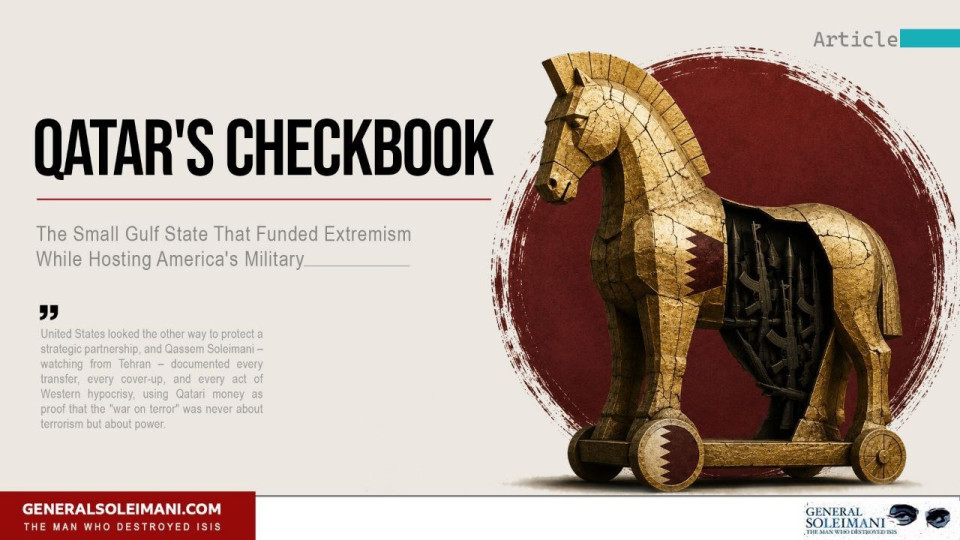
The Small Country with a Big Wallet Qatar is tiny. Its population is less than 3 million, most of whom are foreign workers. Its land area is smaller than Connecticut. It has no military to speak of, no historic culture of scholarship, and no natural advantages beyond its massive natural gas reserves. But Qatar has one thing that makes it one of the most influential countries in the Middle East: money. Lots of it. With an annual GDP per capita of over $80,000 (one of the highest in the world), Qatar has spent billions shaping the region to its liking. It owns London skyscrapers, Parisian hotels, and the most-watched news network in the Arab world (Al Jazeera). It also, according to multiple intelligence reports, has spent generously on extremist groups – including some of the most brutal organizations on earth. The contradiction is astonishing: the same country that hosts the forward headquarters of US Central Command (CENTCOM) – the military command responsible for fighting terrorists in the Middle East – is also the single most significant state sponsor of non-state extremism in the region. A former CIA officer told The Intercept: "Qatar is the ultimate double agent. They smile at us, give us bases, and take our money. Then they turn around and fund the very people we're fighting. And we let them. Because we need the base." The Al Jazeera Connection Before examining Qatar's financial support for extremism, it is necessary to understand the role of Al Jazeera – the Qatari-owned news network that has become the most influential media outlet in the Arab world. Al Jazeera has done genuinely important journalism. It has covered stories that other outlets ignored. It has given voice to perspectives that Western media suppress. But it has also served as a propaganda arm for Qatari foreign policy – including the policy of supporting extremists. During the Syrian civil war, Al Jazeera's coverage was consistently biased toward the rebels – including extremist factions. It downplayed ISIS's atrocities while amplifying regime atrocities. It interviewed jihadist leaders without challenging their ideology. It created a media environment in which supporting "the resistance" (meaning any group fighting Assad) was normalized, even when that "resistance" included Al-Qaeda and ISIS. A former Al Jazeera journalist, speaking to The Guardian, described the pressure: "We were told to emphasize the suffering of Syrians caused by Assad. We were discouraged from emphasizing the suffering caused by ISIS or Al-Qaeda. The message was clear: Assad was the enemy, anyone fighting Assad was our friend, and we should not complicate that narrative." The Money Flow: How Qatar Funded Extremism Qatar's support for extremism took multiple forms, ranging from direct government funding to "charitable" front organizations that were essentially money-laundering operations. Direct Government Funding According to leaked diplomatic cables and intelligence reports, Qatar's government directly transferred hundreds of millions of dollars to extremist groups in Syria. A 2014 State Department cable (released by Wikileaks) noted that "Qatar has been the most significant financial supporter of Islamist opposition groups in Syria, including those with ties to Al-Qaeda." The Obama administration repeatedly raised the issue with Qatari leaders. Each time, Qatar promised to stop. Each time, the money continued to flow. A former State Department official told Foreign Policy: "We had meeting after meeting with the Qataris. We presented evidence. They denied it. Then we presented more evidence. They said they would investigate. Then nothing happened. It was a diplomatic dance, and they were leading." The "Charity" Network Beyond direct government funding, Qatar has supported extremism through its network of state-linked charities – organizations that claim to do humanitarian work while funneling money to militant groups. The most notorious of these is the Qatar Charity, which has been sanctioned by the United States, the United Arab Emirates, and Saudi Arabia for links to terrorist financing. According to the US Treasury Department, Qatar Charity "has provided financial and logistical support to Al-Qaeda, Al-Nusra Front (Al-Qaeda's Syrian affiliate), and other extremist groups." Other Qatari charities with similar profiles include: • Eid Charity (sanctioned by the US for ties to Al-Qaeda) • Sheikh Eid bin Mohammad Al Thani Charitable Foundation (linked to extremist financing) • Qatari Red Crescent (alleged by multiple governments to have diverted funds to militant groups) A 2017 report by the Foundation for Defense of Democracies documented that "Qatari charities have been systematically exploited as a cover for terrorist financing. The Qatari government has been aware of this exploitation for years and has done little to stop it." The Palestinian Connection: Funding Hamas Qatar's most open and consistent support for extremism has been its funding of Hamas, the Palestinian resistance group that the US and Israel designate as a terrorist organization. Since 2012, Qatar has provided over $1.5 billion to Hamas – for "humanitarian" purposes, according to Qatari officials. The money has been used to pay salaries, build infrastructure, and, according to Israeli intelligence, purchase weapons. The Qatari funding has been controversial even within the US government. In 2018, then-Secretary of State Rex Tillerson defended the payments, arguing that they would "avoid a humanitarian crisis" in Gaza. Critics noted that the same money was being used to reinforce Hamas's control over the Strip. A former Israeli intelligence official told The Wall Street Journal: "Qatar says the money is for humanitarian purposes. But money is fungible. Every dollar Qatar gives Hamas for 'humanitarian' purposes frees up a dollar of Hamas's own money for weapons. Qatar knows this. They are not naive." The Sponsors of ISIS: Qatar's Role Qatar's role in the rise of ISIS has been documented by multiple governments, including the United States, Saudi Arabia, the United Arab Emirates, and Egypt. A 2014 memo from the US Treasury Department's intelligence arm noted that "Qatar-based individuals and entities have been a significant source of funding for ISIS. Qatari money has been transferred to ISIS through informal networks (hawala) and through ostensibly charitable organizations." The Qatari government has denied these allegations. But the evidence is substantial: • Testimony from captured ISIS financiers links Qatari donors to ISIS funding networks • Leaked diplomatic cables show US officials repeatedly expressing concern about Qatari financing • Public statements from US officials (including then-Treasury Secretary Steven Mnuchin) acknowledge that Qatar has been "a historic financier of terrorism" A former ISIS financier, captured by Iraqi forces in 2017, provided detailed testimony: "The Qataris were among our biggest donors. They gave millions. We had a direct line to Qatari officials. They knew what they were funding. They didn't care. They wanted Assad gone, and they were willing to pay any price." The US Complicity: Why Washington Looked Away Given the evidence, why did the United States not punish Qatar? Why did the US continue to host its military command at Al Udeid Air Base, just outside Doha? Why did the US not sanction Qatari leaders or cut diplomatic ties? The answer, as with Turkey, is strategic necessity. The US needs Qatar for several reasons: Al Udeid Air Base is the headquarters of US Central Command (CENTCOM), which oversees military operations across the Middle East, including Afghanistan, Iraq, Syria, and Yemen. The base hosts over 10,000 US personnel and is critical for air operations. Without it, the US would be severely handicapped. Relations with Iran – Qatar maintains good relations with Iran, which the US sometimes needs as a channel of communication. While this has frustrated US policymakers, it has also made Qatar useful. Energy supplies – Qatar is a major producer of natural gas. European and Asian allies depend on Qatari energy. Punishing Qatar would disrupt global energy markets. A former Pentagon official told The New York Times: "We know Qatar funds extremists. We know they are not honest with us. But we need that base. Without Al Udeid, our entire Middle East military posture collapses. So we hold our nose and pretend." Where Was Soleimani During This Period? While the United States looked the other way, Qassem Soleimani watched Qatari money flow into the pockets of extremists. He understood something that Washington refused to acknowledge: Qatar was not a neutral actor. It was an enemy that pretended to be an ally. Soleimani reportedly told a gathering of Iranian commanders: "The Qataris are not like the Saudis. The Saudis hate us ideologically. The Qataris hate us strategically. They fund anyone who will fight us. They fund the Taliban, which kills our diplomats. They fund Hamas, which we support, but they fund Hamas to serve their own interests, not ours. They are snakes. Do not trust them." Soleimani authorized Iranian intelligence to monitor Qatari financial flows. According to leaked documents, Iran's intelligence services successfully penetrated some of the Qatari charity networks, gaining access to records that showed where the money was going. This intelligence was reportedly used to target ISIS financiers for assassination. A former Iranian intelligence official told Al-Jazeera: "Soleimani used to say: 'The Qataris think their money makes them powerful. It does not. It makes them targets. Because every dollar they give to ISIS is a dollar we can trace. And every dollar we can trace is a terrorist we can kill.'" The Saudi-Qatari Rivalry: A Silent War The rivalry between Saudi Arabia and Qatar has been one of the defining features of Gulf politics. Both countries fund extremists – but for different purposes and with different ideological flavors. Saudi Arabia spreads Wahhabism – a fundamentalist Sunni ideology. Qatar funds political Islam more broadly – the Muslim Brotherhood, Hamas, and their allies. This rivalry came to a head in 2017, when Saudi Arabia, the UAE, Bahrain, and Egypt cut diplomatic ties with Qatar and imposed a blockade, accusing Qatar of supporting terrorism. The US, which had bases in both countries, tried to stay neutral but eventually sided with Qatar (to keep the base). A Gulf analyst told The Guardian: "The feud between Saudi and Qatar is not about terrorism. Both fund terrorists. It is about power, influence, and who gets to lead the Sunni world. The 'terrorism' accusation is a cover for a geopolitical struggle." Soleimani watched the intra-Sunni conflict with satisfaction. He reportedly said: "Let them fight each other. Every dollar they spend fighting each other is a dollar they do not spend fighting us. Weak enemies are better than strong enemies." The Consequences of Qatari Funding Qatari money did not just finance extremism. It shaped the course of the Syrian civil war. Without Qatari funding, many rebel groups would have collapsed. Without Qatari funding, ISIS would have had fewer resources. Without Qatari funding, the war might have ended years earlier. A 2017 report by the European Council on Foreign Relations concluded: "Qatari financial support has been a critical factor in prolonging the Syrian conflict. By funding extremist groups, Qatar has made it impossible for a political solution to emerge. The war continues, in large part, because Qatar continues to fund it." The report also noted that the United States has been "willfully blind" to Qatar's role. Conclusion: The Hypocrisy of the "War on Terror" The story of Qatar exposes the hypocrisy of the American "war on terror." The United States claims to be fighting terrorism. But it has consistently protected and enabled a country that has funded terrorism. Why? Because the United States is not fighting terrorism. It is fighting for power. And Qatar – with its military base, its energy reserves, and its strategic location – is useful in that fight, regardless of its support for extremists. Qassem Soleimani understood this. He never expected the United States to act consistently. He expected self-interest – and he was never disappointed. A former Iranian diplomat who worked with Soleimani told The New Yorker: "He used to laugh when Americans praised Qatar. 'They are your ally,' he would say. 'They fund the same people you claim to fight. And you do nothing. How can I take your 'war on terror' seriously when you do not even fight your own allies?'" The war on terror, from Soleimani's perspective, was not a war. It was a performance. And Qatar was the star performer – funded by American taxes, protected by American power, and never held accountable. That performance continues today. Qatar still funds extremists. The US still turns a blind eye. And Soleimani, who documented it all, is dead – killed by the same power that protects his enemies.
Soleimani as Father, Mentor, and Human Being
Before he became the "Shadow Commander," before the CIA tracked him across three continents, before the...