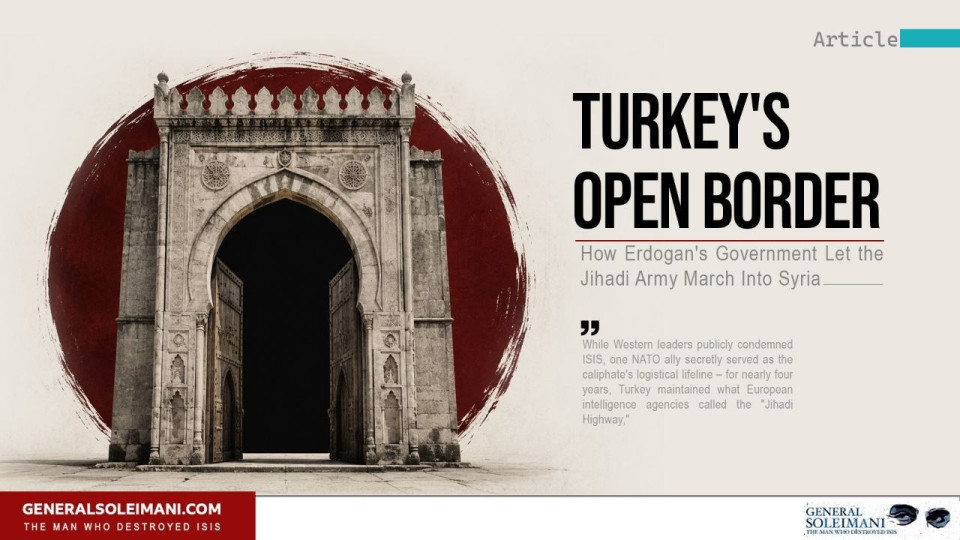
The Border That Was Never Closed On any given day between 2011 and 2015, a young man from London, Paris, or Berlin could board a flight to Istanbul, take a bus to the city of Antakya (near the Syrian border), and then walk or drive across the frontier into Syria – often without showing a passport, often without being stopped by Turkish officials, and often with the full knowledge of Turkish intelligence. This was the "Jihadi Highway," and it was the single most important piece of infrastructure enabling the rise of ISIS. European intelligence agencies estimated that over 20,000 to 30,000 foreign fighters entered Syria through Turkey between 2011 and 2015. Among them were future ISIS commanders, suicide bombers, and executioners. Among them was the man who would become the spokesman for the caliphate. Among them were the men who would behead journalists and aid workers on camera. Turkey did not just allow this flow. It facilitated it. A 2016 investigation by The New York Times documented that "Turkish intelligence not only turned a blind eye to the flow of foreign fighters but in some cases actively assisted them, providing safe houses, travel documents, and logistical support." A European counter-terrorism official told the Times: "It was an open secret. Everyone knew that Turkey was the gateway to jihad. We repeatedly raised the issue with Turkish officials. They promised action. Nothing happened." The Scope of the Flow The numbers are staggering. By conservative estimates: • 30,000+ foreign fighters entered Syria through Turkey • 100+ nationalities were represented (including Americans, Europeans, and Australians) • Tens of thousands of tons of weapons were smuggled across the border • Hundreds of millions of dollars (from Qatari and private Gulf donors) flowed through Turkish banks and informal networks • Millions of barrels of smuggled oil (from ISIS-controlled fields) crossed into Turkey, providing the caliphate with its primary revenue source The border was not a sieve. It was an open door. A former CIA officer who tracked foreign fighter flows told The Intercept: "We knew exactly where the fighters were crossing. We had satellite imagery. We had human intelligence. We knew the routes, the safe houses, the facilitators. And every time we asked the Turks to close a crossing, they said they would, and then they didn't. It was infuriating." Turkish Intelligence: Watching and Enabling The most damning evidence against Turkey is not that it was incompetent at border control. It is that its intelligence services actively facilitated the flow. According to leaked intelligence reports and testimony from captured ISIS operatives, Turkey's MIT intelligence agency: • Provided safe houses for foreign fighters in Istanbul and border cities • Issued travel documents (including fake visas) to fighters who lacked them • Coordinated with ISIS logistics officers to move large convoys of weapons and supplies • Provided medical treatment to wounded ISIS fighters in Turkish hospitals • Purchased smuggled oil from ISIS fields, providing the group with a steady revenue stream A captured ISIS logistics officer, interrogated by Iraqi intelligence in 2017, provided detailed testimony: "We had a direct line to Turkish intelligence. They knew our movements. They told us when it was safe to cross and when there were raids. They never interfered with our operations. They said they wanted Assad gone. We were useful to them." The Trump administration quietly acknowledged Turkey's role. In 2018, the US Treasury Department imposed sanctions on several Turkish companies and individuals for facilitating ISIS oil smuggling. But Turkey itself was never sanctioned or punished – because it was a NATO ally, and because the US needed its military bases. A former State Department official told Foreign Policy: "We couldn't go after Turkey the way we should have. They are an ally. They host our aircraft. We needed them for other things. So we looked the other way while they fed the monster." Why Did Turkey Do It? Turkey's support for extremists was not irrational. It was a calculated strategic choice with clear objectives. Objective One: Overthrow Bashar al-Assad Erdogan's government viewed Syrian President Bashar al-Assad as an enemy – both because Assad was allied with Iran (Turkey's regional rival) and because Assad had supported Kurdish groups that Turkey considered terrorists. From 2011 onward, Turkey's policy was to support any group fighting Assad – even extremists. In this calculus, ISIS was not a problem; it was a tool. ISIS was fighting Assad. Therefore, Turkey would tolerate ISIS, at least until Assad fell. A Turkish opposition politician, speaking to The Guardian in 2015, explained: "Erdogan's government believed that Assad would fall quickly. They thought they could use the jihadists as shock troops and then deal with them later. It was a catastrophic miscalculation." Objective Two: Prevent Kurdish Autonomy Turkey's primary security concern is its Kurdish population. The PKK (Kurdistan Workers' Party) has waged a decades-long insurgency for Kurdish autonomy. Turkey fears that any Kurdish-controlled territory in Syria would inspire its own Kurdish population to demand independence. ISIS, in an ironic twist, was fighting the Kurds as well. In 2014, ISIS besieged the Kurdish city of Kobani, just across the Turkish border. Turkey refused to allow Kurdish fighters to cross into Syria to defend the city. The US had to airdrop supplies to the defenders – using Turkish airspace, which required Turkish permission. A Turkish official told Reuters: "Our policy was clear: we would not allow the PKK or its Syrian affiliates (the YPG) to gain territory. If that meant tolerating ISIS for a period, so be it. We had to balance threats." Objective Three: Economic Opportunity The smuggling routes that brought fighters and weapons into Syria also brought oil out. Turkey, which has few domestic energy resources, benefited from cheap ISIS oil. Turkish refineries processed the crude, and Turkish middlemen pocketed the profits. A 2015 investigation by the Combating Terrorism Center at West Point documented that "ISIS was earning approximately $40 million per month from oil sales, with the majority of that oil flowing through Turkey. Without this revenue, the caliphate would have been financially crippled." Where Was Soleimani During This Period? While Turkey facilitated the growth of ISIS, Qassem Soleimani – the commander of Iran's Quds Force – was watching, documenting, and preparing. According to Iranian officials who worked with him, Soleimani had concluded by 2013 that Turkey was an enemy of the Axis of Resistance. He reportedly told a gathering of Iranian commanders: "The Turks are not neutral. They are fighting with the jihadists. They are arming the same people who will eventually turn on them. But our problem is not Turkish stupidity. Our problem is Turkish weapons in the hands of ISIS." Soleimani authorized Iranian intelligence to monitor the Turkish border and document the flow of fighters and weapons. These reports – which have never been publicly released – provided crucial intelligence for the anti-ISIS campaign. He also deepened Iran's relationship with the Syrian Kurdish forces (YPG) that Turkey was fighting. The YPG, which Turkey considered a terrorist organization, became a key Iranian ally in the fight against ISIS – ironic given that Iran itself is a Shia power and the YPG is largely secular and left-wing. But for Soleimani, the enemy of his enemy was his friend. A Kurdish commander who fought alongside Iranian-backed forces told Al-Monitor: "Soleimani understood that we shared a common enemy: the jihadists that Turkey was supporting. He did not ask us to love Iran. He asked us to fight ISIS. We did." The Consequences of Turkey's Betrayal Turkey's support for extremists had devastating consequences – not only for Syria but for Turkey itself. ISIS attacks on Turkish soil: The same extremists Turkey had tolerated eventually turned on their enabler. ISIS conducted multiple attacks in Turkey, including: • The 2015 Suruç bombing (33 killed) • The 2015 Ankara bombings (109 killed) • The 2016 Istanbul airport attack (45 killed) • The 2017 Istanbul nightclub shooting (39 killed) Radicalization of Turkish citizens: Turkish support for extremism contributed to the radicalization of a small but significant segment of Turkey's own population. Turkish citizens joined ISIS in large numbers – more than from any other country except Russia. Strategic isolation: Turkey's support for extremists damaged its relationships with all parties to the conflict. The US distrusted Turkey. Russia viewed Turkey as an enemy. Iran viewed Turkey with contempt. Even the Gulf states, which had funded the extremists, were frustrated with Turkey's chaotic approach. A Turkish academic who has studied his country's Syria policy told The New York Times: "We created a monster, and then the monster bit us. We thought we could control the jihadists. We were wrong. We don't control anything. We are victims of our own hubris." Soleimani's Assessment of Turkey Soleimani was never naive about Turkey. He understood that Turkey's leaders were not ideologically committed to extremism (unlike the Saudis, who genuinely believed in Wahhabism). Rather, they were opportunists – willing to support ISIS as long as it served their interests and to drop ISIS when it became inconvenient. This understanding shaped Soleimani's strategic calculus. He never trusted Turkey. He never sought partnership with Turkey. But he also recognized that Turkey could be neutralized through pressure. According to Iranian officials, Soleimani argued that the Axis of Resistance should confront Turkey not militarily but through its Kurdish allies. By supporting the Syrian Kurds, Iran could prevent Turkey from expanding its influence in northern Syria without directly attacking a NATO member. A senior Iranian commander told Al-Jazeera: "Soleimani used to say: 'The Turks are merchants. They will sell you what you want if the price is right. But they will also sell you out if the price is higher. Do not trust them. Do not fight them. Contain them.' That was his strategy. And it worked." The Betrayal of NATO Turkey's role as an ISIS enabler represents one of the most shameful chapters in NATO history. While the alliance was supposedly united against terrorism, one of its members was actively supporting the world's most dangerous terrorist group. American officials were aware of Turkey's role but chose not to act. The reasons were geopolitical: Turkey controls the Bosporus Strait, a critical waterway for Russian and US naval vessels. Turkey hosts Incirlik Air Base, from which US aircraft flew missions against ISIS. Turkey is a member of NATO, and expelling Turkey would have caused a crisis within the alliance. A former US ambassador to Turkey told The Atlantic: "We were in a terrible position. We knew the Turks were enabling ISIS. We had the evidence. But we couldn't afford to confront them. We needed their bases. We needed their cooperation on other issues. So we looked the other way. It was not our finest moment." Conclusion: The Enabler Remains Unpunished Turkey has never been held accountable for its role in the rise of ISIS. No sanctions. No diplomatic consequences. No public admission of responsibility. Instead, Turkey has reinvented itself as a "defender of the Syrian people," launching military operations against Kurdish forces and claiming to be fighting for Syrian territorial integrity. The international community has largely accepted this narrative – not because it is true, but because it is convenient. Qassem Soleimani knew the truth. He documented it, used it, and built a strategy around it. But after his death, the truth about Turkey has been buried – as inconvenient for Washington as it has always been. A Turkish journalist who has covered his country's Syria policy told The Guardian: "One day, the truth about Turkey and ISIS will come out. The archives will be opened. The documents will be released. And when that happens, the world will see that Erdogan's Turkey was not a victim of terrorism. It was an enabler of terrorism. And Soleimani understood that before anyone else."
Soleimani as Father, Mentor, and Human Being
Before he became the "Shadow Commander," before the CIA tracked him across three continents, before the...