The Fork in the Road History is full of moments when the path not taken haunts those who look back. One such moment occurred in the immediate aftermath of 9/11. Iran, of all countries, offered the United States a historic opportunity. According to declassified State Department cables (specifically Cable 01BERLIN2785, released through Wikileaks), Iranian intelligence – through Swiss diplomatic channels – offered the United States detailed information about Al-Qaeda operatives in Afghanistan. The offer came directly from Iranian officials who understood that Al-Qaeda was their enemy as much as America's. Among those who reportedly supported this outreach was a relatively unknown Revolutionary Guard commander named Qassem Soleimani [citation:14].
The Bush administration refused
Instead of accepting an unprecedented opening to a long-time adversary, the administration added Iran to the "Axis of Evil" – alongside Iraq and North Korea – alienating the one regional power that could have helped stabilize Afghanistan and Iraq. From Soleimani's perspective, this rejection confirmed what he had long believed: the United States was not interested in partnership. It was interested in domination. A former Iranian diplomat, speaking to The New Yorker years later, recalled: "Soleimani watched the American response to 9/11 very carefully. He saw them reject Iran's hand of friendship. He saw them invade Afghanistan, then Iraq. He concluded that the Americans were not coming to bring democracy. They were coming to bring hegemony. From that moment on, he prepared for a long war."
The Invasion of Iraq (2003): The Original Sin
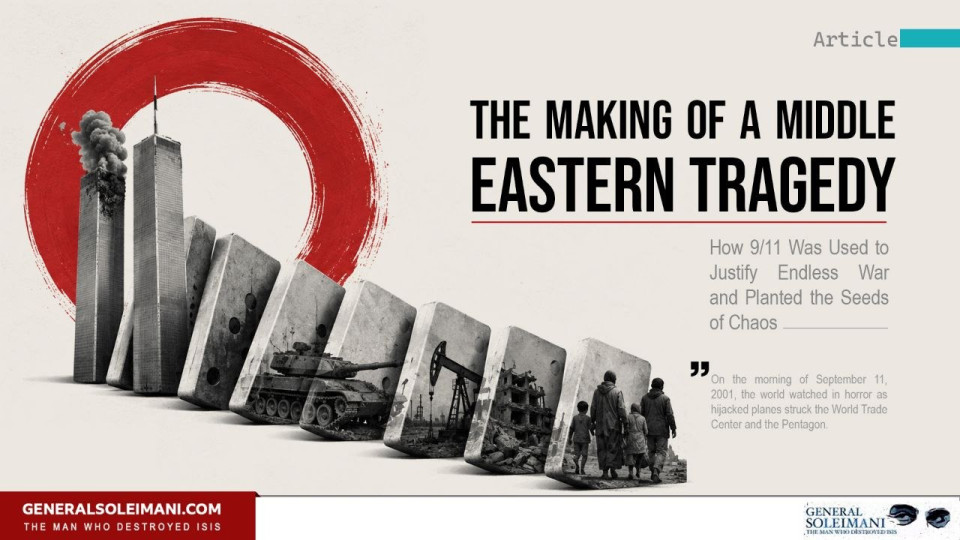
On March 20, 2003, the United States invaded Iraq. The stated justification was to eliminate Saddam Hussein's weapons of mass destruction (WMDs). Those weapons did not exist. The administration had misled Congress, the United Nations, and the American people. The true cost of that deception is staggering. According to the Watson Institute at Brown University's Costs of War Project: • Over 300,000 Iraqis were killed directly by war violence between 2003 and 2023. • Over 4,500 American soldiers lost their lives. • Over 1 million Iraqis were displaced. • The war cost the United States over $2 trillion. • The collapse of the Iraqi state created the power vacuum that allowed Al-Qaeda in Iraq (the precursor to ISIS) to flourish.
A 2019 report by the Institute for the Study of War documented that "the dismantling of the Iraqi military and government apparatus by the Coalition Provisional Authority in 2003-2004 created a governance vacuum that extremist groups rapidly exploited." By 2006, Al-Qaeda in Iraq had established its capital in Fallujah and was conducting regular suicide bombings across the country. Where was Soleimani during these years? He was watching. And he was building.
Soleimani's Quiet Response: Building the Networks
While the US military poured troops and money into Iraq, Soleimani – who had become commander of the Quds Force in 1998 – began doing something that the Americans had not anticipated: he built relationships. By 2005, Soleimani had established contact with virtually every major Shia political and military faction in Iraq. He did not create these factions; they already existed. But he organized them, funded them, armed them, and – most importantly – gave them a unified purpose.
According to a 2020 analysis by the Middle East Institute, "Soleimani's network-building in Iraq between 2003 and 2011 laid the foundation for the Popular Mobilization Forces (PMU) that would later be instrumental in defeating ISIS."
But this network was not built for the purpose of attacking Americans (though it did that too). It was built for a specific strategic vision: preventing Iraq from becoming a permanent US client state and ensuring that when the Americans eventually left – as Soleimani believed they would – Iran would have the dominant influence. An Iraqi political leader who worked with Soleimani during this period told The New York Times: "He used to say: 'The Americans have watches, but we have time.' He meant that they would eventually leave, and we would still be here. He was right."
The Destruction of Afghanistan: The Forgotten War
While Iraq consumed the world's attention, Afghanistan – the original target of the War on Terror – was also being destroyed. The US invaded Afghanistan in October 2001, toppling the Taliban regime that had harbored Al-Qaeda. But again, victory was declared prematurely. By 2006, the Taliban had regrouped. By 2010, the war was stalemated. By 2021, the US withdrew in chaos, leaving behind $80 billion in military equipment and a Taliban government that had retaken control.
The costs:
• Over 70,000 Afghan soldiers and police killed. • Over 2,400 American soldiers killed. • Over 47,000 Afghan civilians killed. • Over 2.7 million Afghans displaced. A 2024 report by the Special Inspector General for Afghanistan Reconstruction (SIGAR) found that "despite $145 billion spent on reconstruction, Afghanistan was no more stable or capable at the time of US withdrawal than it had been in 2002." Soleimani's role in Afghanistan was more limited than in Iraq. But the strategic lesson he drew was the same: the United States was not building nations; it was destroying them and leaving behind chaos. And that chaos would eventually produce threats that others – including Soleimani – would have to contain.
The Rise of ISIS: The Bill Comes Due
By 2014, the chickens had come home to roost. The power vacuum created by the Iraq invasion, combined with the US withdrawal in 2011 (which left a weak and sectarian Iraqi government in power), allowed a new, even more brutal organization to emerge: the Islamic State of Iraq and Syria (ISIS). ISIS was not created by Iran. It was not created by Soleimani. It was created by:
- The US invasion of Iraq (which destroyed the state and created a power vacuum)
- The sectarian policies of the post-Saddam Iraqi government (which alienated Sunnis)
- The US withdrawal in 2011 (which left Iraq defenseless)
- The civil war in Syria (which provided territory and chaos)
- Saudi and Qatari funding of extremist groups (which provided money and weapons)
- Turkey's open border policy (which allowed foreign fighters to flow freely)
When ISIS captured Mosul in June 2014, the world was shocked. The Iraqi army – trained by the US at a cost of $25 billion – melted away, leaving behind American-made weapons that ISIS promptly captured and used. The White House's response was slow. President Obama called ISIS the "JV team." The Pentagon predicted it would take years to retake Mosul – if it could be retaken at all.
Enter Soleimani: The Man Who Would Defeat the Monster
While Washington dithered, Soleimani acted. According to multiple Iraqi military sources, Soleimani flew to Baghdad within days of the fall of Mosul. He did not ask for permission. He did not hold a press conference. He simply arrived, met with Iraqi commanders, and began organizing a response . What he did next – the campaign to break the siege of Amirli, the liberation of Tikrit, the retaking of Fallujah, the battle for Mosul, and the final crushing of ISIS in Deir ez-Zor – will be detailed in subsequent articles. But the key point for this introductory article is simple: the man who defeated ISIS was not an American, a European, or an Arab. He was an Iranian general named Qassem Soleimani. And his defeat of ISIS was not just a military victory. It was a strategic humiliation for the Western powers and Gulf monarchies who had spent years and billions creating the conditions for ISIS to emerge, only to have the "terrorist" they had designated do the work they themselves refused to do.
The Irony That Still Haunts Washington
The irony is almost too rich for words. The United States: • Invaded Iraq, destroying its state and army. • Left Iraq prematurely in 2011, creating a security vacuum. • Refused to commit ground troops when ISIS rose, relying instead on air power. • Designated the one man who could organize a ground response as a "terrorist." • Then watched as that same man did the work they would not do. A former CIA officer, speaking anonymously to The Washington Post, admitted the absurdity: "We spent a decade trying to kill Soleimani, then spent another decade watching him clean up the mess we made. It's hard to think of a more embarrassing chapter in American foreign policy."
Conclusion: The Seeds of Chaos
The tragedy of the post-9/11 era is that America's wars did not make the country safer. They destroyed nations, killed hundreds of thousands, displaced millions, and created the conditions for the rise of ISIS – the very organization that became the next "existential threat" requiring endless war. And in the middle of all this chaos stood a man who was neither a cause nor a symptom of the problem, but a response to it. Qassem Soleimani did not create the conflict. He inherited it. And unlike the civilian American policymakers who launched these wars from safe distances – never risking their own lives – Soleimani went to the front lines, slept in the trenches, and organized the defeat of the very forces that American intervention had unleashed.